Showing posts with label erosion. Show all posts

Monday, August 20, 2007

Coastal Erosion Landforms - Features and Formation

Coastal Erosion Features

There are 3 main groups of coastal features which result from coastal erosion:
1. Headlands and Bays
2. Caves, Arches, Stacks and Sumps
3. Cliffs and Wave-cut platforms

Before you revise the formation of these landforms, have a look at this video and make sure you are able to identify the landforms from their distinctive features.


1. HEADLANDS AND BAYS

Headlands are resistant outcrops of rock sticking out into the sea, whilst bays are indents in the coastline between two headlands.

So how do headlands form?

- Headlands form along discordant coastlines in which bands of soft and hard rock outcrop at right angles to the coastline.
- Due to the presence of soft and hard rock, differential erosion occurs, with the soft, less resistant rock (e.g. shale), eroding quicker than the hard, resistant rock (e.g. chalk)
- Where the erosion of the soft rock is rapid, bays are formed
- Where there is more resistant rock, erosion is slower and the hard rock is left sticking out into the sea as a headland.
- The exposed headland now becomes vulnerable to the force of destructive waves but shelters the adjacent bays from further erosion.


Named Examples of Headlands and Bays: (LEARN!)

The Dorset coast has excellent examples of Headlands and Bays
e.g. Swanage Bay and the Foreland (a headland)


2. CAVES, ARCHES, STACKS and STUMPS

Once a headland has formed it is then exposed to the full force of destructive waves and it gradually begins to erode. you need to be able to describe the erosion of a headland and the features that form.

For the sequence of formation see the animation below:


So how does a headland erode and caves, arches, stacks and stumps form?

- Firstly, the sea attacks the foot of the cliff and begins to erode areas of weakness such as joints and cracks, through processes of erosion such as hydraulic action, wave pounding, abrasion and solution;
- Gradually these cracks get larger, developing into small caves;
- Further erosion widens the cave and where the fault lines runs through the headland, two caves will eventually erode into the back of each other forming an arch, passing right through the headland.
- A combination of wave attack at the base of the arch, and weathering of the roof of the arch (by frost, wind and rain), weakens the structure until eventually the roof of the arch collapses inwards leaving a stack, a stack is a column of rock which stands separate from the rest of the headland.
- The stack will continue to erode, eventually collapsing to form a stump which will be covered by water at high tide.


Named Examples:

The Foreland (Dorset Coastline) is a great example of a headland which shows these features - there is a distinctive stack called Old Harry and a stump known as Old Harry's Wife.

A good example of a distinctive arch, also found on the Dorset Coast is Durdle Door.


3. CLIFFS AND WAVE-CUT PLATFORMS

Cliffs are steep rock faces along the coastline, they tend form along concordant coastlines with resistant rocks parallel to the coast.

So how do cliffs and wave-cut platforms form?

- The erosion of a cliff is greatest at its base where large waves break - here hydraulic action, scouring and wave pounding actively undercut the foot of the cliff forming an indent called a wave-cut notch whilst the cliff face is also affected by abrasion as rock fragments are hurled against the cliff by the breaking waves.
- This undercutting continues and eventually the overhanging cliff collapses downwards - this process continues and the cliff gradually retreats and becomes steeper.
- As the cliff retreats, a gently-sloping rocky platform is left at the base, this is known as a wave-cut platform which is exposed at low tide.


Named Examples:

Good examples of cliffs and wave-cut platforms can be found at Hunstanton (North Norfolk) and Flamborough Head (Yorkshire)

-------------------------------------------------------------------------------
REVISING COASTAL EROSION FEATURES

Remember - for each erosion feature try and learn a labelled diagram to show its formation, make sure that you also mention examples of erosion processes when describing how the features are actually formed. Finally to access the highest marks remember to name and locate examples of each feature.

- Swanage Bay (Dorset Coast)
- The Foreland (Headland) (Dorset Coast)
- Old Harry (Stack) (Dorset Coast - off of the Foreland)
- Old Harry's Wife (Stump) (Dorset Coast - off of the Foreland)
- Durdle Door (South Dorset Coast)
- Cliffs and Wave-cut platforms - Hunstanton (N Norfolk) and Flamborough Head (Yorkshire)

Click here for examples of 6 mark answers on the formation of coastal erosion features

Follow up Links:
Erosion of a Headland
Animations of Cliff formation
Cliff Features and Arch Animation

Podcast: Coastal Defences
You can listen to a podcast of this post below - to download a copy to listen to on your .mp3 player click here.

Coastal Processes: Erosion, Transport and Deposition

Remember, there are 3 main processes that cause a coastline to change:
1. Erosion
2. Transport
3. Deposition.

There are number of factors which affect each of these processes - we are going to start by exploring erosion processes and the factors that can affect the amount of erosion that may take place along a coastline.

COASTAL EROSION

Erosion Processes:
Erosion is the wearing away of rocks, at the coast there are 6 main types of erosion processes in action (see animations here):

1. ABRASION (this is also known as corrasion) - this is where rock fragments are hurled at cliffs by breaking waves, gradually scraping away at the cliff face;

2. HYDRAULIC ACTION - as waves break against the cliff face, the pressure of the breaking wave can compress air in cracks. This compressed air gradually forces open the crack in the rock - as this process continues, the rock becomes increasingly weakened.

3. SOLUTION (this is also known as corrosion) - this occurs where the salt water is able to dissolve some of the chemicals in rocks - for example, limestone cliffs are gradually weakened as the salt water dissolves the calcium carbonate in the limestone.

4. SCOURING - this occurs at the base of the cliff as the waves break and swirl around, gradually removing loose rock.

5. ATTRITION - this is where rock fragments carried by the waves hit against each other and gradually wear down to form sand and silt

6. WAVE POUNDING - the sheer force of waves hitting against the cliff face

These processes of erosion form a series of distinctive landforms at the coast.

Rates of Coastal Erosion
So what are the factors that determine how much erosion can take place at the coast?

1. The Resistance of the Rocks - e.g. limestone, chalk and granite are resistant rocks (often forming cliffs and headlands) and erode relatively slowly, whilst less resistant rocks such as clay are easily eroded.

2. The Strength of the waves - affected by the wind strength and duration and its fetch

3. The shape of the coastline (which is dependent on its geology) - on concordant coastlines, rocks are parallel to the wave front and therefore rates of erosion are similar along the coastline. On discordant coastlines, differential erosion may occur, where bands of hard and soft rock outcrop at right angles to the sea. Consequently headlands and bays form along discordant coastlines and whilst headlands remain exposed to the force of the waves, bays are sheltered.

Click on the diagram below for a summary of factors affecting coastal erosion


COASTAL TRANSPORT

The second process operating at the coast is transport. Material eroded by the sea is carried within the water in a number of ways, minerals dissolved from rocks are carried in solution, whilst small rock fragments, light enough to be held within the water, float in suspension. The largest rock fragments which are too heavy to be picked up by the waves, are transported by the process of traction, this is where they roll along the bed when the waves pick up enough energy. Finally, medium sized rock particles, which cannot be carried by the waves all the time, are moved by saltation. This is where during times of higher wave energy the particles are picked up and then dropped again as the wave looses its energy.

The main form of transport operating at the coast is that of LONGSHORE DRIFT.

Longshore drift is the process by which sand and pebbles are moved along a beach by the movement of the waves.


COASTAL DEPOSITION

Material is moved up the beach by the swash at an angle which is controlled by the prevailing wind. The backwash then carries material back down the beach at right angles to the coastline under the influence of gravity. Gradually the material is moved along the coastline, its direction being controlled by the prevailing wind direction.

The final process operating at the coast is that of deposition - this is where material that is too heavy to be transported any more is left behind, building up the beach. Due to the importance of energy in transporting sand and shingle, it is the largest material that is deposited first. A number of distinctive features may form due to coastal deposition.

Follow up links:
Animations of Coastal Erosion Processes (BBC Bitesize)
Transport and Deposition (BBC Bitesize)

Key Terms Check:
Erosion - the wearing away and removal of material
Deposition - the dropping of material
Abrasion - the wearing of rock due to rock fragments being hurled against cliffs
Attrition - the breakdown of rocks as they hit against each other
Hydraulic Action - the force of waves causing rocks to split apart as waves compress air in cracks in the rocks
Wave Pounding - sheer force of water hitting rocks
Solution - where minerals in rocks are dissolved by the action of sea water
Scouring - occurs where water and broken rock fragments swirl around at the base of cliffs gradually wearing rock away.
Longshore Drift - the movement of material along a coastline

Podcast: Coastal Processes
You can listen to a podcast of this post below - to download a copy to listen to on your .mp3 player click here.

Coasts - Energy at the Coast

The coast represents the metting point between the land and sea. Coasts are very dynamic areas and they are constantly change. This change is due to 3 main processes which operate at the coast, 1. Erosion; 2. Transport and 3. Deposition. These 3 processes are all driven by the amount of energy that is available at the coast. The main agents of change at the coasts are waves. Waves are movements of energy throughout the water, but where do waves get their energy from? The answer to this is wind.

As wind blows over the surface of the sea, it creates friction. This frictional drag causes water particles to begin to rotate and energy is transferred forward in the form of a wave. Whilst the water moves forward, the water particles return to their original position. As a wave reaches shallow water, friction between the sea bed and the base of the wave causes the wave to begin to slow down and its shape becomes more eliptical. The top of the wave however, unaffected by the friction, becomes steeper until it eventually breaks. When the wave breaks, water washes up the beach, this is called the swash. The movement of water backdown the beach is called the backwash.

It is the rate at which waves reach the coast which determine whether the main process acting on the coastline is erosion or deposition. There are two main types of waves:

(i) CONSTRUCTIVE WAVES - tend to arrive at the coast at a rate of less than 8 waves per minute, they are low energy waves and are small in height. They have a strong swash and a weak backwash. This means that constructive waves tend to deposit material and build up a beach.

(ii) DESTRUCTIVE WAVES , have much higher energy and tend to arrive at the coast at a rate of more than 8 per minute. They are much larger in height often having been caused by strong winds and a large fetch. These high energy waves have a weak swash but a strong backwash, which erode the beach but pulling sand and shingle down the beach as water returns to the sea.

There are 3 main factors which will affect the strength of a wave and therefore whether it is more likely to erode or build up the coastline:
(i) the strength and speed of the wind - the faster the wind, the more energy is transferred and therefore the bigger the wave that is produced.
(ii) the duration of the wind - this is the length of time for which the wind has blown - the longer the wind blows, the more energy is transferred to the wave
(iii) the fetch - this is the distance over which the wind has blown and therefore how far the wave has travelled. The longer the fetch, the larger the wave is likely to be.

Follow up links:
Excellent Animation showing a wave forming and breaking (Wycombe High School)
Wave Machine Simulator - create your own ocean wave
Ocean Surface Wave - Wikipedia
Waves - includes animation of swash and backwash (BBC Bitesize)
Constructive and Destructive Waves Animation (Wycombe High School)

Key Term Check:
Swash - the movement of water and material up the beach (in direction of prevailing wind)
Backwash - the movement of water and material back down the beach (straight back down due to gravity
Constructive wave - low energy wave with greater swash than backwash - tends to build up the beach
Destructive wave - high energy wave with greater backwash than swash - tends to erode beach

Podcast: Energy at the Coast - Wave Formation
You can listen to a podcast of this post below - to download a copy to listen to on your .mp3 player click here.

Friday, November 10, 2006

River Processes

As a river flows along its course it undertakes 3 main processes which together help to shape the river channel and the surrounding valley. These processes are erosion, transport and deposition.

RIVER EROSION
River erosion is the wearing away of the land as the water flows past the bed and banks. There are four main types of river erosion. These are:

  1. Attrition - occurs as rocks bang against each other gradually breaking each other down (rocks become smaller and less angular as attrition occurs)
  2. Abrasion - this is the scraping away of the bed and banks by material transported by the river
  3. Solution - chemicals in the river dissolve minerals in the rocks in the bed and bank, carrying them away in solution.
  4. Hydraulic Action - this is where the water in the river compresses air in cracks in the bed and banks. This results in increased pressure caused by the compression of air, mini 'explosions' are caused as the pressure is then released gradually forcing apart parts of the bed and banks.
Here is a great little animation by a teacher from Somerset (Noel Jenkins) showing the main processes of river erosion - make sure you learn them!

RIVER TRANSPORT
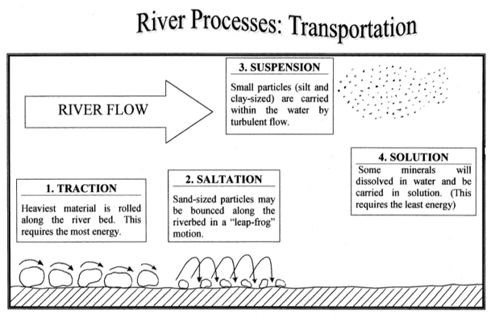
Material may be transported by a river in four main ways: solution, suspension, saltation and traction (see diagram). The type of transport taking place depends on (i) the size of the sediment and (ii) the amount of energy that is available to undertake the transport. In the upper course of the river there is more traction and saltation going on due to the large size of the bedload, as a river enters its middle and lower course there is alot of finer material eroded from further upstream which will be carred in suspension. Here is a great little movie showing the process of saltation.

Check out the following animation showing the processes of river transport

DEPOSITION
Deposition is where material carried by the river is dropped. This will occur when there is no longer sufficient energy to transport material. Deposition of material may result in the formation of distinctive features such as slip off slopes (on the inner bends of meanders); levees (raised banks) and of course the floodplain itself. Remember - it is the largest material that will be dropped first as it requires the most energy to be transported. eroded from further upstream which will be carried in suspension.

This animation looks at sediment deposition as a river enters a lake - look at what size material is deposited first.

Now test your understanding:
Try out these drag and drop games to match up the key processes of erosion and transport with their correct definitions.